|
Leather Slings (Leder Gewehrriemen, Lederriemen, Leder Trageriemen)
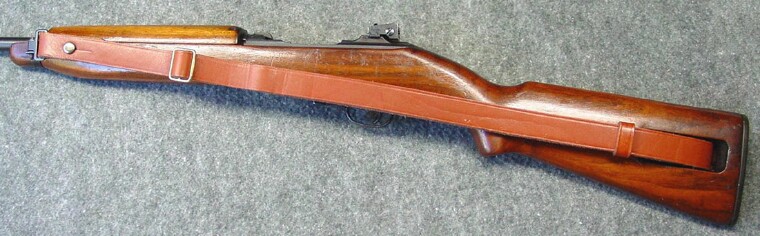
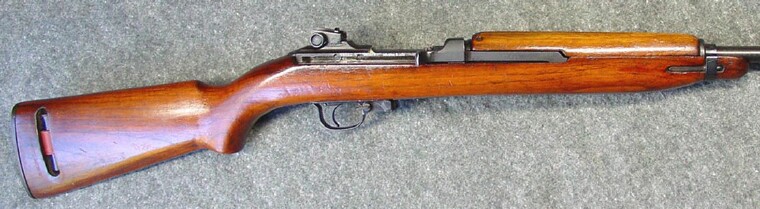
The Austrian Bundesheer used U.S. issue canvas slings provided as military assistance. The Bundespolizei and Gendarmerie used leather slings.
Uniform leather gear used by the Bundespolizei was dyed black. For the Gendarmerie the leather was dyed brown.
Leather gear used by the Austrian Gendarmerie post WWII was manufactured by Stolla of Vienna (Stolla Wien). Stolla had manufactured leather accessories
for the Austrian Bundespolizei, Gendarmerie, and military since the 1920's. After the war the products they made for the military and police
were restricted to those of Austria only. Stolla went out of business in 1970.
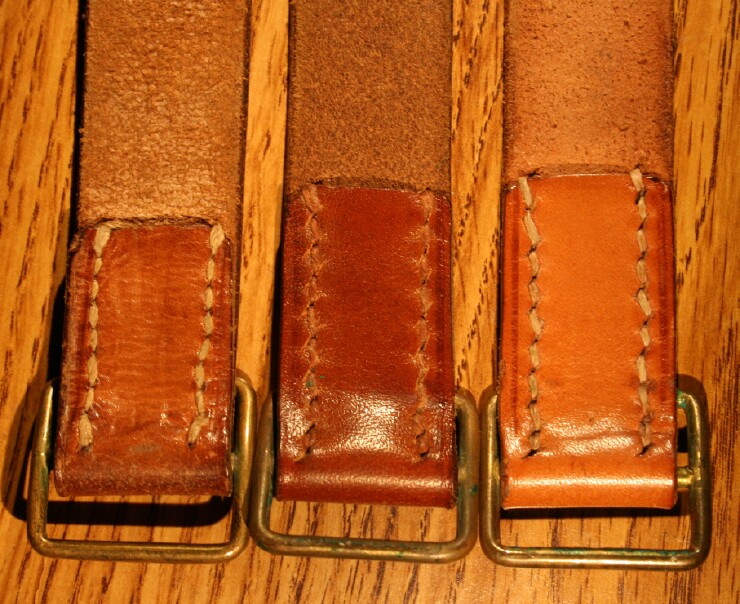
The M1 carbine slings manufactured by Stolla for the gendarmerie were approximately .09-.180" thick, .97" wide , and 51-52" long. Original dimensions
changed slightly with wear and use of the sling. The thicker slings did not fit through the stock's slingwell with the standard U.S. oiler (see below). Some can
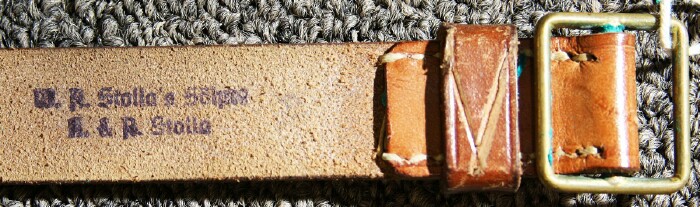
be made to work by softening the leather before feeding it around the U.S. oiler. The buckle was made using heavy gauge wire
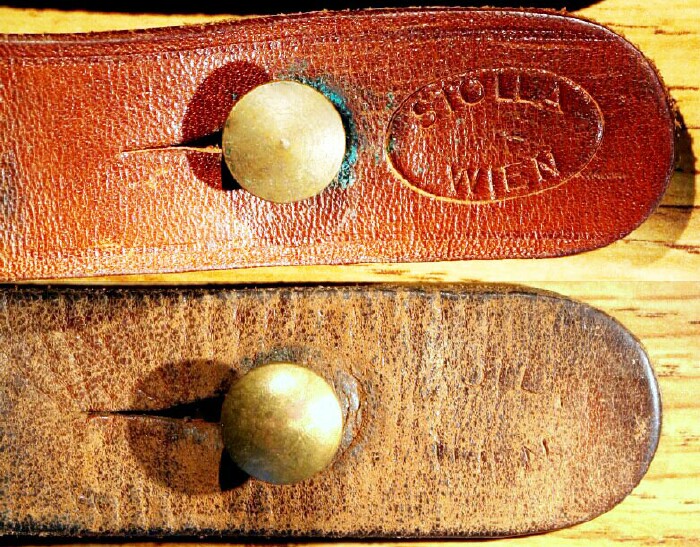
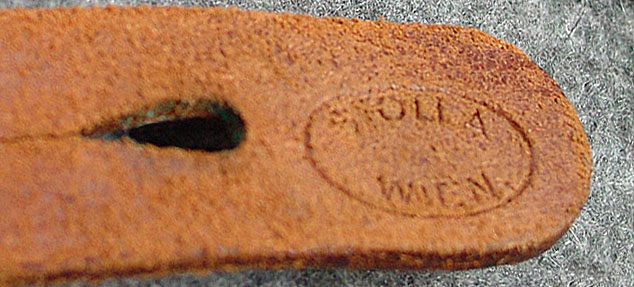

Leather slings very similar in dimensions and appearance to those made by Stolla were also used by the Austrian Gendarmerie.
Possibly manufactured after Stolla closed. These slings do not have a manufacturers mark or gendarmerie markings.
| Special thanks to Glen Efinger who has helped much in sorting these out. |

Buckles made by Stolla were made using heavy gauge brass wire approximately
1.20" in diameter, 1.29-1.30" in height, and 1.15-1.16" wide.
Procurement Office Acceptance Marks |
 |
1st Gendarmerie-Beschaffungsamt 56
(Gendarmerie procurement office 1956)
|
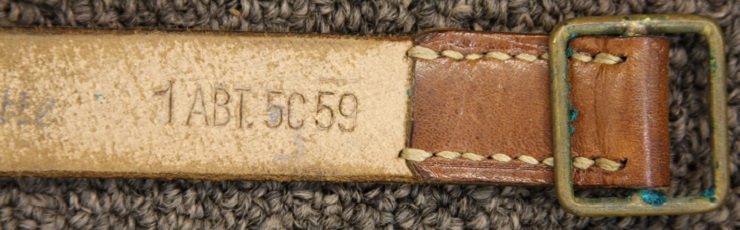 |
1st Abteilung Section, 5C, 59
(Gendarmerie procurement office 1959)
|
 |
1st Abteilung Section, 5C, 62
(Gendarmerie procurement office 1962) |
Agency Markings |
Occasionally the name of the gendarmerie office and/or gendarme may be found on the slings.
|

Landes Gendarmerie Kommando NiederOsterreich
(Lower Austria)
|

Bezirksgendarmeriekommando
Volkermarkt, Karnten
(District Gendarmerie Command, the town of Volkermarkt, Carinthia)
|
Replacement Oilers
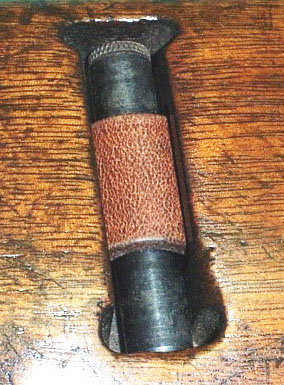 
The thickness of some of the leather slings prevent their use with a U.S. GI oiler. Some of these slings will work if
treated with a leather softener.
Some of the slings are simply too thick to work with the U.S. GI oiler. Plastic
dowels smaller in diameter were cut to the length of the oilers and used by the gendarmerie.
Leather Magazine Pouches (Leder Magazintasche or Patronen Tasche)
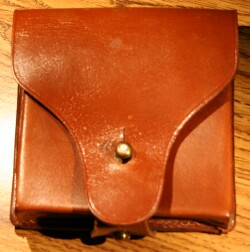
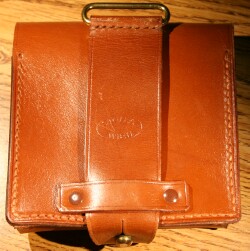
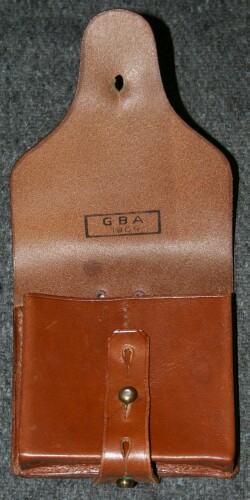
Stolla also manufactured leather magazine pouches for use by the Austrian police and
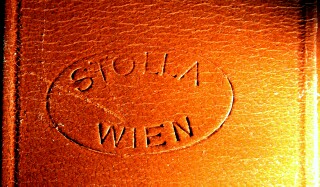
gendarmerie. Stolla pouches are marked Stolla Wien on the backside, have an adjustable
strap for carrying the pouch on the carbine buttstock or uniform belt, and a flap that
folds over the magazines and is secured by sliding a hole in the flap over a metal knob
on the front of the pouch. Stolla manufactured a single 15 round magazine pouch and a
pouch that held two 15 round magazines side by side.
The polizei uniform leather was black. The Gendarmerie uniform leather was brown.
The Bundesheer used the U.S. issue canvas magazine pouches.
The Gendarmerie metal pouch trim designated the rank of the officer they were assigned
too.
- Officers in charge:
| Metal or Plastic |
- Unter Officers (NCO's):
| Silver |
- Officers:
| Gold |

Advertisement in June 2001 circular from Tennessee Guns for black leather
magazine pouches from the Austrian police. Tennessee Guns sold many
of the M1 carbines imported from Austria by INTRAC of Knoxville, TN. |
Not all of the leather gear for Austria's police and gendarmerie was manufactured by Stolla. The magazine pouches
below do not have a manufacturer's imprint or mark and are not adjustable for the carbine stock, they were worn
on the uniform belt only. The pouches below are identifiable as belonging to the Austrians by the markings
under the flap. As can be seen in the pictures, the markings varied somewhat. Pouches from the same manufacturer
may have been used in Germany.

Black leather used by the Bundespolizei (these were used by the Vienna Polizei). Brown leather used by the Gendarmerie. |

Handprinted under the flap of several pouches are the surname of the officer(s) they were assigned too.
Some of the pouches have the serial number of an M1 carbine. Each person was assigned one M1 carbine,
one rifle sling, and one ammo pouch. |
 | 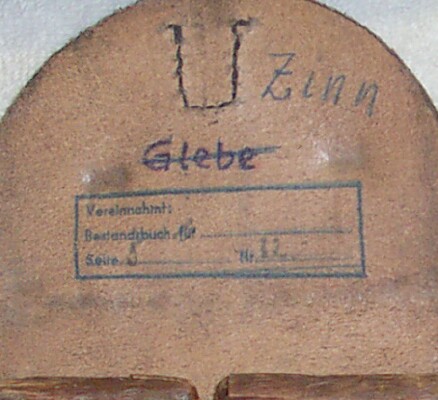
| | | Zinn: | Sergeant / Inspector |
| | Glebe: | Master Sergeant / District Inspector |
| | Verelnnchint: | Received |
| | Bestundibuch Nr: | Inventory Book Number |
| | Seite: | Page |
| | Nr: | Number |

The belt loop fit only the uniform belt, not over the stock like those made by Stolla.
These brown pouches appear to have been black ones that were sprayed brown. |
Barrel Muzzle Cap
Harsh winter weather conditions led a number of European countries to find alternatives to cloth
or metal muzzle caps for protecting rifle barrels from the elements. During WWII the Russians, and Germans on the
eastern front, used a muzzle cap made of rubber that was designed to be shot through, or off, and later replaced.
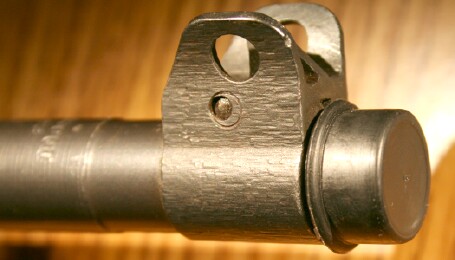
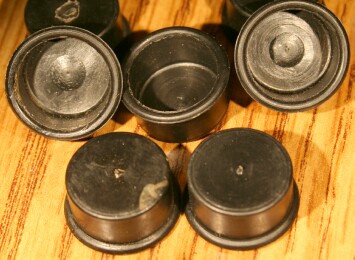
With the advent of plastics, a number of countries switched from rubber to plastic. The Austrians designed a plastic
muzzle cap for the M1 carbine that served this same purpose.
Rear Sight Protectors
These rear sight protectors for the U.S. adjustable rear sight have been found on U.S. M1 carbines utilized by
Zoll Wache (Tariff Guards). They are constructed of a rubber coated metal plate on either side of the sight, overlapping
the sight edges. They're held in place by a screw forward and aft of the sight adjustment.

Image by www.euroarms.net, © 2007 |
These have not been observed on any other M1 carbines used by the other Austrian agencies.
Ammunition (Patronen)
Hirtenberger Patronen und Rohrwerke
manufacturer of various .30 Caliber Carbine cartridges, including plastic cartridges
| |
Hirtenberger case markings
HP
HP Gend (for the Austrian Gendarmerie)
HP with an unknown polizei marking (for the Austrian Polizei)
HP 30M1 K7.62 (for the Austrian Bundesheer) |
 |
Note: INTRAC received their M1 carbines from Austria in Hirtenberger munitions tubes, two carbines to a tube. Hirtenberger manufactures various large caliber ammunition for tanks, artillery, etc.
Blank Ammunition (Knall Patronen)
Südsteirischen Metallindustrie (South Steyr Metallurgy)
Plastic blank cartridges for the Bundesheer

paper bag containing 100 rounds of plastic cartridges | 
The plastic cartridges have no head case markings
and a larger primer. PMC casing is for comparison
only. |
|

The primer & brass casing head are attached to a
one piece black plastic casing approximately 2.2 mm thick. | 
The black plastic "bullet" is not a bullet at all, it's the end of the plastic casing.
The X at the end releases the blast from the gunpowder ignition. |
|
| (brass casing and full jacketed bullet is caliber .30 carbine mfg. by PMC, shown for comparison purposes only) |
|
| (Südsteirischen Metallindustrie ammo courtesy Roger Mickelson)
|
Dummy Cartridges
GECO: Genschow Co. is now owned by the major ammunition manufacturing conglomerate RUAG Ammotec, based in Austria but with manufacturing facilities throughout Europe.
Non firing Dummy Cartridges for Zoll (Tariff Guard)

Image by www.euroarms.net, © 2007 |
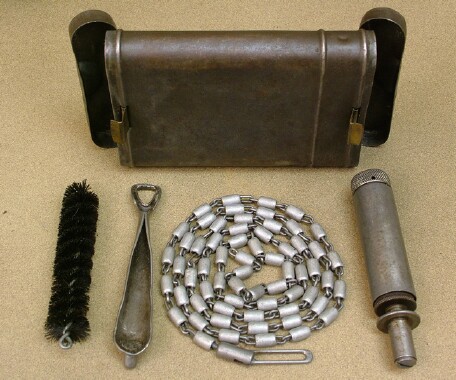
Cleaning Kit used by the Gendarmerie for the M1 carbine
The rifle cleaning kit for the German K98 rifle was introduced in 1934 and designated M34. The above User Manual indicates this
was the same cleaning kit issued to the gendarme for cleaning the M1 carbine.
Gendarmerie Karabiner M1 User Manual
In 1957 the Ministry of the Interior published a User Manual for the Gendarmerie. The manual is is approximately
3" wide x 4.5" tall with the front and back covers made from water resistant vinyl. The manual consists of 68 pages covering
the operation, maintenance, use, disassembly and cleaning of the M1 carbine. Illustrations are high quality with
photographs depicting the more important procedures.
The inside cover of the below manual is stamped in ink with the date December 2, 1984 and the central Gendarmerie school in
Mödling, in the state of Lower Austria.

vinyl protective covering | 
Introduction | 
Table of Contents | 
Gendarme w/ KM1 |
|
|
 |  |
Gendarmerie Karabiner M1 Drill
In 1959 the Ministry of the National Defense published a Training Regulation Manual for the Bundesheer.
The manual is is approximately 3" wide x 4.5" tall with the front and back covers made from water resistant vinyl.
The manual consists of 107 pages covering basic training regulations, including 3 pages of drill instructions for the
M1 carbine. This training manual was also issued to the Gendarmerie.
The inside cover of the below manual is stamped in ink with the date January 13, 1982 and the central Gendarmerie school in
Mödling, in the state of Lower Austria.

Cover Page | 
Drill Instructions |
Gendarmerie Almanac
The Gendarmerie published an almanac every couple years. The below example is from 1958 and consists of 455 pages
detailing command structure, Gendarmerie posts throughout the entire nation, and the personnel assigned to each
of the posts. Some of the slings and/or ammo pouches have the names of the personnel and/or the serial numbers of
the M1 carbines they carried. This almanac allows us to determine where an individual, and their M1 carbine, was
assigned in Austria. The next almanac I could locate was for 1964.
Research requests for individuals whose name is known are accepted by contacting me via the discussion forum.

Cover Page | 
Gendarmerie stations in Lower Austria (94) | 
Gendarmerie Command for Lower Austria |
|