|
|
 | Mysteries |
|
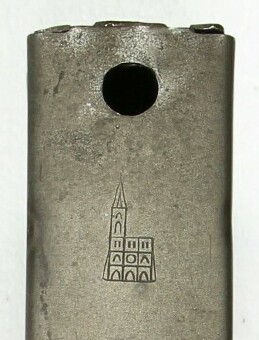
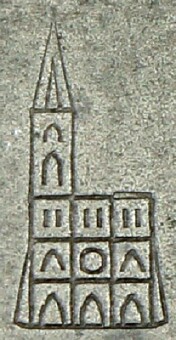
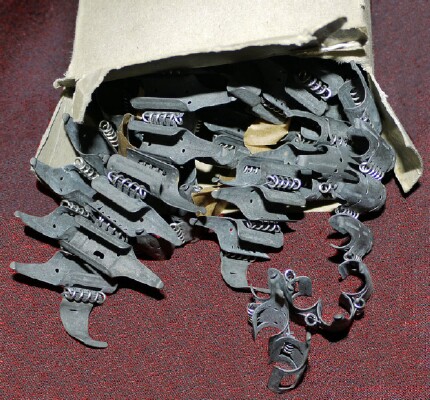
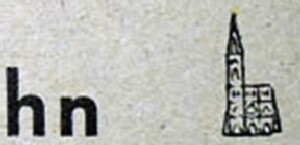
The Church MysteryThe West German Bundeswehr used a 30 round magazine for their M1 Carbines that has a distinctive logo of a church, upside down and located on the back of the magazine towards the bottom. A number of these magazines were imported into and sold in the U.S.A. Packaging they came with indicated they were manufactured in West Germany but had no other information.
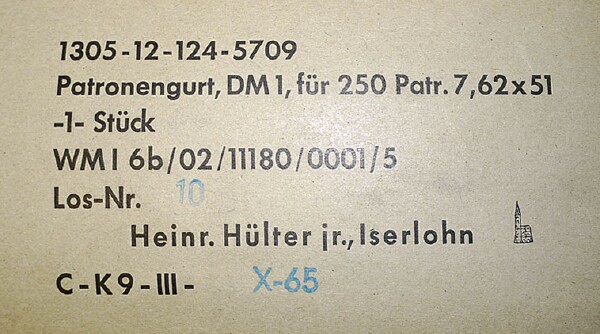
The number 12 within the NATO stock number identifies the item was for use by Germany. The sequence with WM is believed to be the contract number. The date of manufacturer is believed to be 1965. The current NATO stock system indicates this part has been replaced. The supply sources still on record are various German military logistics supply agencies. Hein. Hülter Jr. in Iserlohn was a metal factory founded in 1890 (magazine advertisement sold on EBay Germany from unknown German magazine in 1929). Iserlohn is located approximately 90 miles east of Düsseldorf in North Rhine-Westphalia, Germany.
| |||||||||||||||||||||



|
|
The Mystery of Hessen
 |
Hessen had a post war population of approximately 4,025,000 within 13,117 sq miles, an area slightly larger than the State of Maryland. The Office of Military Government, U.S. (OMGUS) divided Hesse into three regional districts: Darmstadt, Kassel, and Wiesbaden. All cities with a population of 5000 or more were directed and assisted in starting their own police force. Outside the cities, in the governmental districts Wiesbaden and Darmstadt a Gendarmerie was formed and, in the district Kassel a Landjägerei. [Die Geschichte der Hessischen Polizei und mehr .... by Kraus, Grimminger, & Schmidt]
The eastern border of Hessen faced the Russian zone/East Germany. The Hessen border police were established in March 1946.
By June 1949 the Hessen Polizei had received 2,458 M1 Carbines and 4,590 pistols from the U.S. Military Government (OMGUS). [OMGUS Civil Administration Division, Bad Nauheim, 08 Sep 1949, Semi-Annual German Police Personal & Equipment Report as of 30 Jun 1949]
The Mystery: What markings were used by Hessen and what happened to their Carbines?
In November 1945 the Allied Control Council for Germany approved the use of certain weapons by the German police. The German police within the American Occupation Zone were subsequently armed with S&W Victory Revolvers and U.S. M1 Carbines. One of the mandates of the Allied Control Council directive was the marking of the weapons used by the German Police. The manner in which they were marked, and where, was decided by OMGUS at the Land level, in this case meaning OMGUS Hessen in Frankfurt.
The first edition of the book U.S. Karabiner M1 by Wolfdieter Hufnagl, included a photograph of the markings used by Hessen and indicated Hessen had removed the U.S. markings from their carbines. During communication with Hufnagl he indicated his source for the photograph and information was a police officer in Hessen. Hufnagl had not observed the carbines himself.
 U.S. manufacturer and serial number removed, a different serial number has been added U.S. Karabiner M1 by Wolfdieter Hufnagl |  The Hessen crest placed on the receiver bevel
|
In 1993 INTRAC of Knoxville, TN imported approx. 7800 M1 Carbines from Austria. Amongst these were carbines Austria purchased from Bavaria in 1955. In 2008 Austria returned approx. 6700 M1 Carbines to the U.S. Army. The army turned the carbines over to the Civilian Marksmanship Program (CMP). Many of the carbines had also been purchased from Bavaria by Austria in 1955. CMP sold the carbines in 2009.
Amongst both groups from INTRAC and CMP were a number of carbines that had the U.S. markings altered. In each case the carbine had been used by Bavaria prior to Austria. Carbines used by one Land within the American Occupation Zone of Germany sometimes made their way to one of the other Lands (i.e. Wurttemberg-Baden to Bavaria and visa versa). It's not known if Bavaria acquired these carbines from Hessen. Removal of U.S. markings is not known to have occurred in Bavaria. Since the carbines in Bavaria were handled by the Germans on a local level by each agency within that locale as opposed to a statewide level for all carbines, the fact the Bavaria agency names on these carbines varied would indicate it wasn't Bavaria that removed them. Austria did not remove U.S. markings. As can be seen in the photographs below, removal of the GI markings was inconsistent, suggesting the order on which markings to be removed may not have been specific and/or clear.
Amongst the Carbines returned from Germany via Austria by INTRAC and CMP

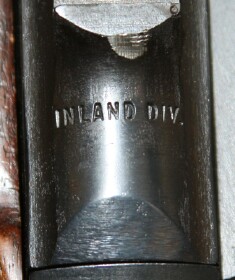
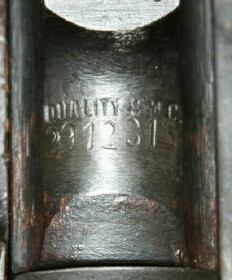
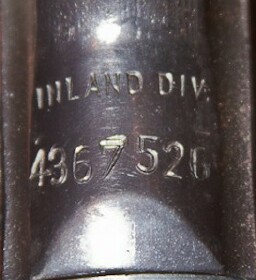

The recoil plate on one of the carbines examined by an armorer at CMP had the markings HE-M stamped into the top. Unfortunately this recoil plate had been separated from the carbine it had been on. Another recoil plate obtained as a spare part by an owner from a source outside of CMP was found to have the markings HE-R. S&W Victory revolvers used by Hessen have the HE-M or HE-R stamped onto the backstrap. The carbines from Austria/Bavaria that have been examined and had markings removed, the recoil plates did not have these markings. However, on many the receiver bevel had been machined to remove non U.S. markings there.

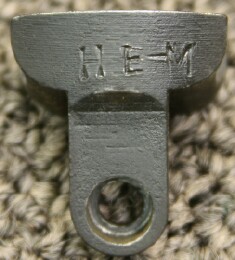

The problem is neither recoil plate was attached to the carbine it had been on and no carbine with either marking on the recoil plate has yet to be found to be examined for the rest of what may or may not have been used by Hessen.
|
|
The Mystery of the Bremen Enclave
 |
The Bremen Enclave was about 1500 square miles, roughly the size of Rhode Island. The population was 486,000 in December 1946. Bremerhaven sits at the entrance to the Waser River at the Atlantic Ocean. Bremen is approximately 40 miles down the Waser river from Bremerhaven. The ports of both cities, and a number of smaller towns in between, became the entry/exit port of all U.S. military personnel and supplies for U.S. Forces in Europe. Bremen was normally used for supplies destined for the Germans in the American Occupation Zone, including Lend-Lease materials. Bremerhaven was normally used for U.S. military supplies and the movement of U.S. military personnel.
The Bremen Police, Bremerhaven Police, German Port Police, and River Police were supplied with American weapons. [OMGUS Arming of the German Port Officers, Shipment 15, Box 121-1, file 43, archives of the Institut für Zeitgeschichte, Munich, Bavaria]. By June 1949 German law enforcement within the Bremen Enclave had received 1,044 M1 carbines and 1,721 pistols from the U.S. Military Government (OMGUS). [OMGUS Civil Administration Division, Bad Nauheim, 08 Sep 1949, Semi-Annual German Police Personal & Equipment Report as of 30 Jun 1949]
The Mystery: What markings were assigned to the German Police in the Bremen Enclave and what happened to their Carbines?
|
|
The Mystery of the U.S. Carbines from West Berlin
In January 1960 the U.S. Army ordered 2,784 M1/M2 carbines for use by the West Berlin Police. As the weapons arrived they were stored at Andrews Barracks and Tempelhof Airfield in the American Sector, and at the Olympic Stadium which was to be a rallying point in the event of a war. 915 of the M1/M2 carbines were allocated for the E-Kommandos, 1869 of the M1/M2 carbines were allocated for Force B (Bereitschaftspolizei aka BEPO). [personal notes kept by officers and the command of the West Berlin Police]
When construction of the Berlin Wall started in August 1961, American forces began distributing weapons.
Horst von Domarus is a retired Berlin police officer who served with BEPO as an armorer. He recalls the weapons were received in September 1961 and all weapons were marked with the West Berlin Police star on the rear sight platform just forward of the carbine's rear sight by him and other armorers. The Berlin Police star has often been referred to as the Berlin sunburst or Berlin flower, based on it's appearance. The Berlin star appears on the Berlin Police belt buckle, helmet insignia, and shoulder patches.
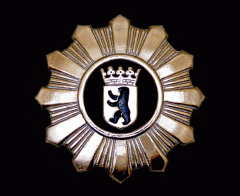 The outer star on the buckle was stamped on the weapons used by the police in West Berlin. To the right is an example of the marking on a Walther P1 pistol. |  |
 simulated example of West Berlin P star on an M1 Carbine |  simulated example of West Berlin star on an M1 Carbine |
The Mystery: Where did the U.S. Carbines used by West Berlin go?
In late 1966 or early 1967 Horst von Domarus and others assigned to BEPO cleaned the American weapons and drove them to Andrews Barracks, where they returned all of them to the U.S. Army, while other German police units in West Berlin did likewise. When the carbines and other weapons were returned to the U.S. Army, the Berlin star was still on them.
If you have seen, own, or know of a U.S. Carbine with this marking, please consider sharing this information using our forum.
|
|